


- HOME
- >
- PROJECT
- >
- Collaborative Research Projects
- >
- Relational Dynamics within Festival Heritage Communities as Social Common Capital: A Quantitative and Qualitative Comparison between Japan and Catalonia, Spain
Relational Dynamics within Festival Heritage Communities as Social Common Capital: A Quantitative and Qualitative Comparison between Japan and Catalonia, Spain
2026.01.28
Project representative:
Masataka Nakayama(Associate Professor/Institute for the Future of Human Society/Kyoto University)
Collaborating researchers and co-researchers:
・Yuko Iwase(Postdoctoral researcher/Graduate School of Humanities/Tokyo Metropolitan University)
・Kengo Konishi(Program-Specific Associate Professor/Institute for the Future of Human Society/Kyoto University)
Introducing this project
This study examines the traditional Catalan folk performance castells (“human towers,” Photo 1) and its sustaining community, Colla Vella dels Xiquets de Valls, as a form of Social Common Capital. Drawing on Hirofumi Uzawa’s concept, the research explores how such cultural practices contribute to stable and meaningful social relationships through a combination of anthropological and psychological methods.
The castells tradition, recognized by UNESCO as an Intangible Cultural Heritage, involves multigenerational participants constructing human towers during festivals. The group Vella, established in 1791, consists of members aged 4 to 89 (at the time of survey), with close kinship and local ties. Activities include regular rehearsals, festivals, communal meals, and shared facilities such as a cemetery and housing, fostering strong group cohesion.
Through participant observation and surveys (online and paper), the study investigated such concepts as relational mobility—freedom and opportunity in forming or leaving relationships—and interdependent happiness, or relationship-oriented well-being. Results showed that 81% of members had family ties within the group and nearly half had participated for over 26 years. Despite strong kinship bonds, most respondents also reported ease in returning after leaving and forming new connections, indicating high relational mobility.
Furthermore, members expressed high levels of affection and group attachment, and demonstrated greater well-being than international averages. The study found that even amid disagreements or temporary withdrawal, members maintained enduring, flexible relationships—what the authors term “long-term loose ties.”
These findings suggest that castells function not merely as a conservation of tradition, but as dynamic Social Common Capital, contributing to personal well-being and community resilience through both stable kinship and flexible social networks.
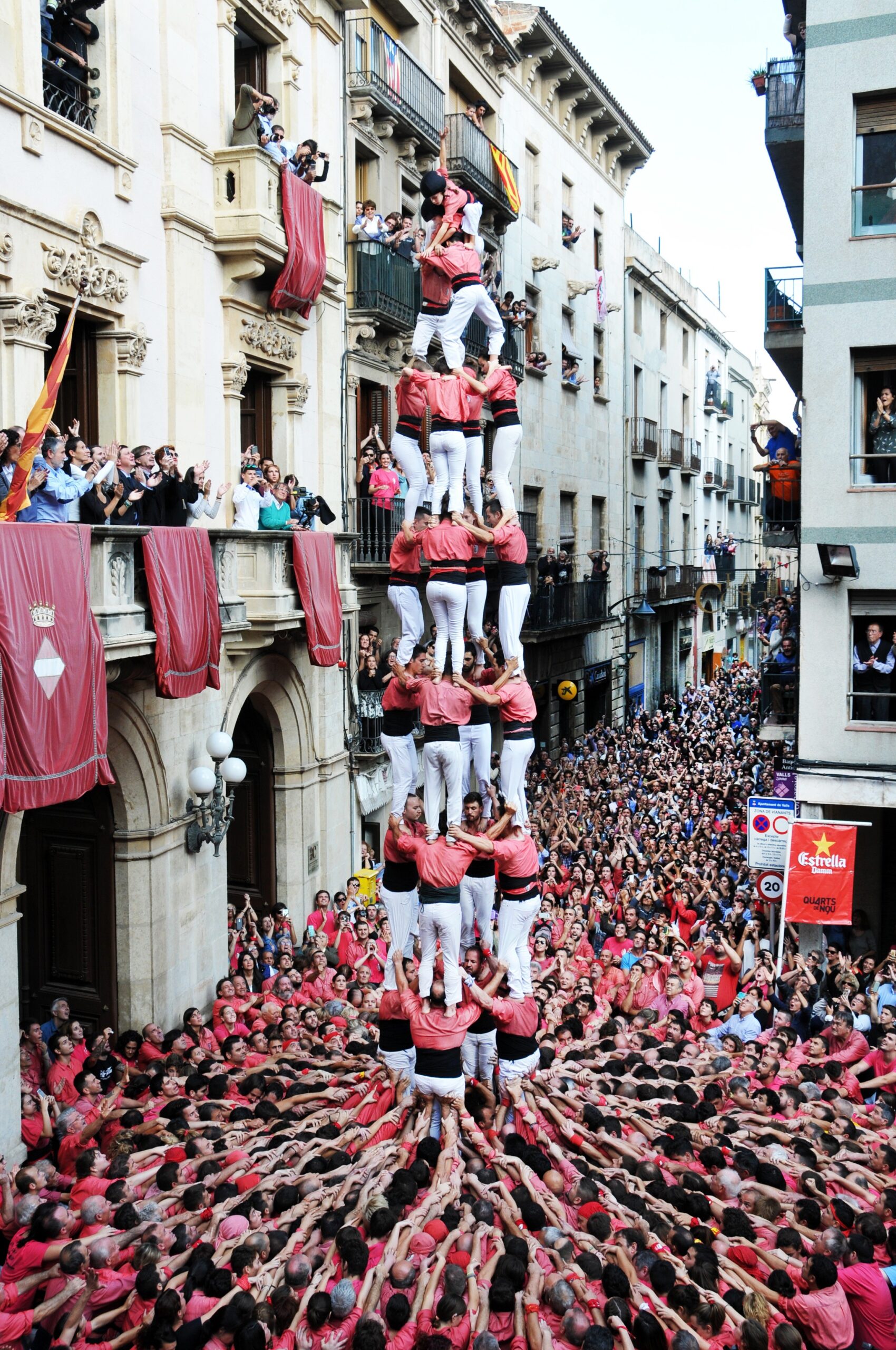
Photo 1 The human towers of Vella
Other related articles
-
2026.02.25
Protected: The Role of Art and Culture in Health and Well-being: Social Implementation Using the INNATE Framework and Positive Health
-
2026.02.25
Protected: アート/文化と健康/ウェルビーイング- INNATE Frameworkとポジティヴヘルスを用いた社会実装
-
-672x372.jpg)
2026.02.25
Protected: Resilience in Comfortable Authoritarian Powers—A New Comparative Perspective on China and Russia