


- HOME
- >
- PROJECT
- >
- Collaborative Research Projects
- >
- Establishing Cognitive Astronomy: Exploring Human Conceptions of the Universe through the Perception of Astronomical Landscapes
Establishing Cognitive Astronomy: Exploring Human Conceptions of the Universe through the Perception of Astronomical Landscapes
2026.01.28
Project representative:
Yoshiyuki Ueda(Associate Professor/Institute for the Future of Human Society/Kyoto University)
Collaborating researchers and co-researchers:
・Hiroyuki Takata(Research Fellow/Public Relations Center/National Astronomical Observatory of Japan)
Introducing this project
This project aims to establish a new interdisciplinary field called Cognitive Astronomy to understand how humans have perceived and interpreted the universe through the cognitive processing of celestial and terrestrial (referring to astronomical) landscape information. Two fundamental questions guide this inquiry: (1) How did astronomical landscapes appear to the human eye? and (2) Why did they appear that way to the human mind? The first question addresses the physical and optical conditions of celestial and terrestrial configurations: how astronomical scenes appeared under specific spatial and environmental conditions. The second question probes the cognitive and psychological biases that shape human perception: how the same astronomical landscape might have been seen differently depending on cultural background, expectations, or perceptual tendencies.
The research focused on the perception of starry skies and the creation of constellations. In contemporary Japanese education, constellations are typically introduced using a Western representational approach, which involves connecting multiple stars to form recognizable shapes or figures. However, anthropological studies have shown that traditional Japanese practices often emphasized individual stars or small star groups to determine time, direction, or seasonal changes, rather than forming elaborate figures. To uncover observers’ default cognitive strategies, we asked participants to freely create constellations, rather than reproduce existing ones, when viewing starry skies.
Participants viewed 24 images of starry skies generated by the open-source planetarium software Stellarium and were instructed to draw constellations under the condition that others might also recognize the patterns they created. The results showed diverse constellation forms even from identical starry skies and, at the same time, revealed common patterns in them (see Figure 1). Groupings often occurred in similar sky regions, likely reflecting perceptual clustering. Many drawn figures resembled living creatures, which may reflect pareidolia, a psychological tendency to perceive familiar shapes, especially living creatures (i.e., human or animal), in ambiguous stimuli.
These findings suggest that while constellation creation is flexible, it is guided by shared cognitive tendencies. Future work will examine how such tendencies shift when practical goals like timekeeping or navigation are introduced. Throughout these investigations, we aim to further reveal how humanity’s worldview is reflected in the perception of astronomical landscapes.
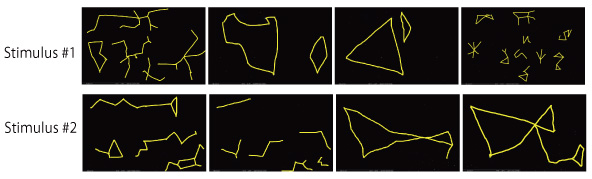
Figure 1. Constellations created by four participants for the same set of starry skies
Other related articles
-

2026.02.25
Protected: The Role of Art and Culture in Health and Well-being: Social Implementation Using the INNATE Framework and Positive Health
-
2026.02.25
Protected: アート/文化と健康/ウェルビーイング- INNATE Frameworkとポジティヴヘルスを用いた社会実装
-
-672x372.jpg)
2026.02.25
Protected: Resilience in Comfortable Authoritarian Powers—A New Comparative Perspective on China and Russia