


- HOME
- >
- PROJECT
- >
- Collaborative Research Projects
- >
- Examining Factors that Help Home-Based Informal Caregivers Balance Work, House Chores, and Caregiving Responsibilities
Examining Factors that Help Home-Based Informal Caregivers Balance Work, House Chores, and Caregiving Responsibilities
2026.01.28
Project representative:
Ayae Kinoshita(Professor/Graduate School of Medicine/Department of Human Health Sciences/Kyoto University)
Collaborating researchers and co-researchers:
・Mayuko Suehara Harada(Technical Assistant/Graduate School of Medicine/Department of Human Health Sciences/Kyoto University)
Introducing this project
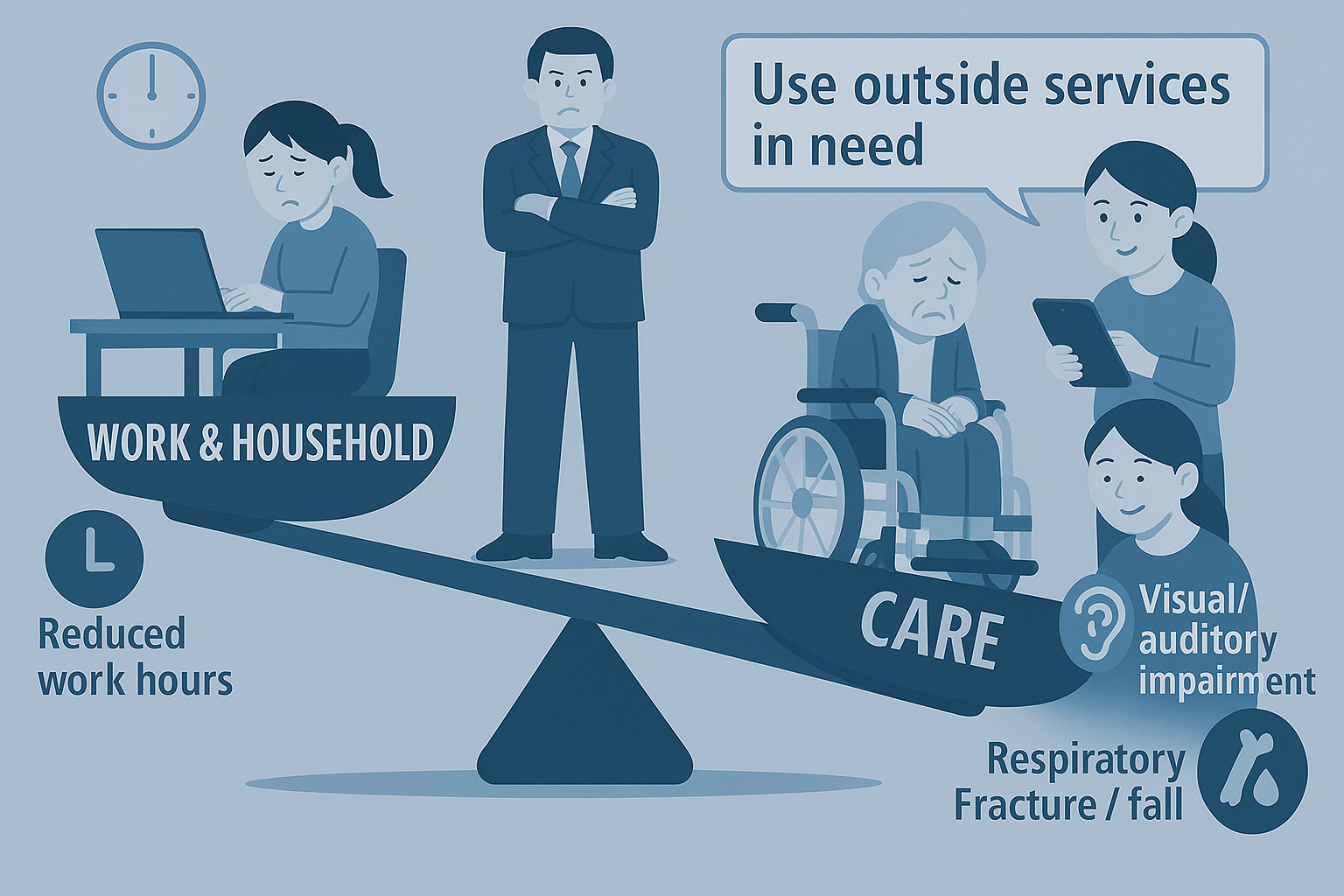
This study examined factors that influence the ability of employed family caregivers to balance their work, household duties, and caregiving responsibilities at home. With Japan, Italy, and Germany leading in population aging, the demand for home-based care is rising. However, caregivers face increasing burdens due to shrinking family support networks and a declining birthrate. Using data collected during the COVID-19 pandemic, the study analyzed how changes in daily life impacted caregiving.
Key findings include that caregiving frequency increased when caregivers lived with their family members, likely due to extended time at home during the pandemic. Additionally, flexible work arrangements (FWA), especially reduced working hours, were unexpectedly associated with increased caregiving frequency. While FWAs are intended to support caregivers, this result suggests that such arrangements may inadvertently intensify caregiving demands.
The study also found that certain health conditions of care recipients, such as visual or hearing impairments, fractures or falls, and respiratory illnesses, were linked to more frequent caregiving. Among these, visual and hearing impairments had the strongest impact. Notably, these sensory impairments are also risk factors for dementia, highlighting the need for better support strategies targeting such conditions.
Overall, the findings suggest that although work flexibility is important, it alone may not be sufficient to ease caregiving burdens. A more nuanced approach is needed to address the complexities faced by caregivers, especially those supporting individuals with sensory impairments.
Other related articles
-
2026.02.25
Protected: The Role of Art and Culture in Health and Well-being: Social Implementation Using the INNATE Framework and Positive Health
-
2026.02.25
Protected: アート/文化と健康/ウェルビーイング- INNATE Frameworkとポジティヴヘルスを用いた社会実装
-
-672x372.jpg)
2026.02.25
Protected: Resilience in Comfortable Authoritarian Powers—A New Comparative Perspective on China and Russia